
How to Make Viral TikTok Slideshows for Your SaaS
Viral is not luck — it is a 9-slide structure, a hook that stops the thumb, and a proof slide that earns trust. Here is the 2026 playbook SaaS founders use to hit 50k+ views without dancing.

Every SaaS founder wants a viral TikTok post. Most assume viral means dancing, trending audio, or a founder with camera confidence and a ring light. For product-led SaaS in 2026, that assumption is wrong — and it is the reason most slideshow attempts die at 400 views.
Viral SaaS slideshows follow a repeatable structure. Not a template from Canva — a content architecture: hook, list, proof, CTA. Nine slides. Under 30 seconds of auto-advanced viewing time. One specific problem your buyer recognises in the first 1.8 seconds. This playbook breaks down exactly how to build that deck — and why the structure matters more than the design tool.
What “viral” actually means for SaaS
For a SaaS founder, viral is not 2 million views from teenagers. Viral is 50,000-200,000 views from people who have the problem your product solves — and a completion rate high enough that TikTok keeps serving the deck to lookalike audiences.
The metric that matters is not likes. It is completion rate — what percentage of viewers who see slide 1 make it to slide 9. Slideshows have a structural advantage here: TikTok auto-advances each slide with music behind it, so the viewer is not deciding to keep watching — the timer is. A hook that lands guarantees 18-27 seconds of watch time before the viewer can swipe away.
That is why slideshows are outperforming talking-head video for SaaS in 2026. And why you do not need to show your face to go viral — see how to promote your SaaS on TikTok without showing your face.
The 9-slide structure every viral deck uses
Every viral SaaS slideshow we have analysed — across B2B, indie apps, and digital products — uses the same skeleton:
- Slide 1: Hook — one claim, large text, high contrast. No logo.
- Slides 2-7: List — one idea per slide, one supporting visual each.
- Slide 8: Proof — screenshot, metric, or quote.
- Slide 9: CTA — one specific action.
Deviate from this and completion rate drops. A 12-slide deck loses viewers on slide 9 when the algorithm has already decided the hook underperformed. A 5-slide deck ends before TikTok registers enough watch time. Nine is the number — not because it is magic, but because it lands in the 18-27 second completion window the algorithm rewards.
Hook rules that stop the thumb
Slide 1 is the entire distribution mechanism. TikTok shows your hook to a small test audience and watches what they do in the first 1.8 seconds. Swipe means the deck is finished — slides 2 through 9 never get served to anyone else.
Three rules for a viral SaaS hook:
- Be specific. “We cut churn by 38%” beats “boost retention” every time. Specificity is what stops the thumb.
- Name the problem, not the product. Your product belongs on slide 9, never slide 1. Leading with your product name triggers the ad reflex.
- One line only. Readable in under two seconds. If a viewer has to read twice, they have already swiped.
For seven hook templates that consistently book demos for B2B SaaS, see our TikTok slideshow hooks guide.
Slides 2-7: one idea, one visual
The middle six slides are a list — steps, mistakes, comparisons, or lessons. Each slide carries exactly one idea in plain founder voice. Not homepage copy. Not bullet walls. One claim, one supporting visual, move on.
The visual should anchor the idea on the slide, not decorate it. If the slide says “we were reporting revenue wrong for 4 months,” the visual should be a spreadsheet, a dashboard, a query — not a generic gradient. Generic visuals are the fastest tell that content is AI-generated without thought. Fix that before you post — see why AI-generated TikTok looks fake.
Slide 8 (proof) and slide 9 (CTA)
Slide 8 is where viral SaaS slideshows separate from content that feels like an ad. Proof is something the viewer can verify in two seconds: a product screenshot, a real metric, a customer quote, a before-and-after. Vague claims on slide 8 kill trust and completion rate together.
Slide 9 is one specific call to action. “Try it free at yoursite.com” works. “Learn more” does not. “Link in bio” works if your bio link is set up. The CTA should name the action, not the intent.
The algorithm signals that boost reach
TikTok ranks slideshows on four signals in 2026:
- Completion rate — did the viewer reach slide 9? Slideshows win here by design.
- Rewatch rate — did they swipe back to re-read a slide? Dense, useful middle slides earn this.
- Share rate — did they send it to a colleague? Contrarian takes and expensive-mistake hooks drive shares for SaaS.
- Profile visit rate — did they click through to your bio? Proof on slide 8 plus a clear CTA on slide 9 drive this.
Avoid the mistakes that kill all four signals at once — recycled LinkedIn carousels, brand voice copy, and ignoring the slideshow format entirely. Full list in our TikTok marketing mistakes guide.
Ship viral decks from your URL in 60 seconds
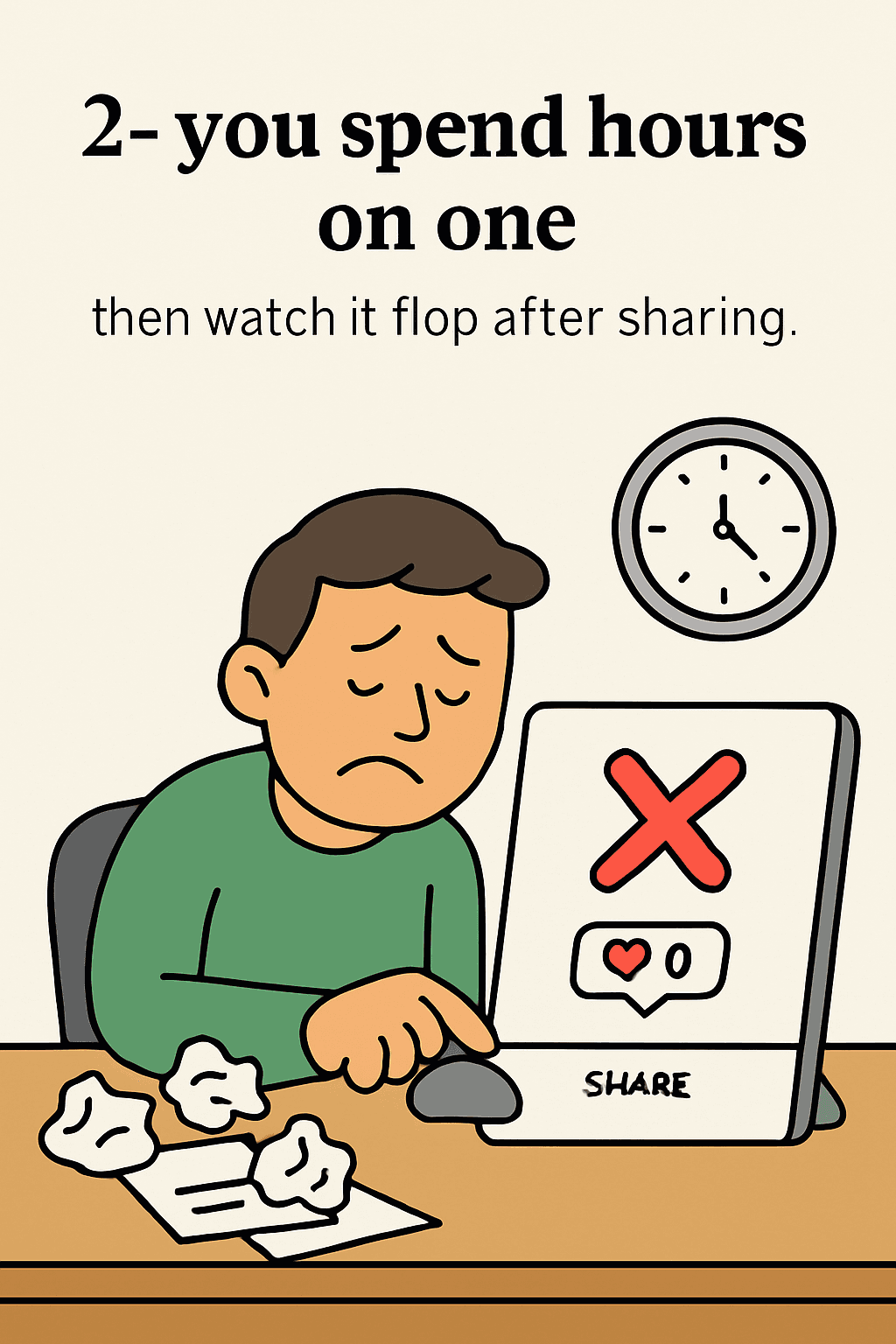
The structure above is simple. Building it by hand is not. Nine slides in Canva — hook, copy, visuals, export, 9:16 crop — takes 3-5 hours per deck. That is why most SaaS founders post once, get 600 views, and quit before the algorithm calibrates.
Slidetik generates the full 9-slide viral structure from your SaaS URL — hook, list slides, proof placeholder, and CTA — in 60 seconds. Pick a story angle, regenerate slide 1 until the hook lands for 1 credit, post the same day. The AI slideshow maker handles structure; you iterate the hook. See pricing from €5/month — about €0.80 per deck on the credit pack.
Viral TikTok slideshows for SaaS are not a creative lottery. They are a weekly habit of shipping one well-structured deck, measuring completion rate, and improving slide 1. Start with the hook. Everything else follows.
Ship the slideshow this week.
Paste your URL. Slidetik generates a 9-slide TikTok deck with copy, AI visuals and your brand colors in 60 seconds. From €5/month.
Try Slidetik — 60sFrequently asked questions
How many slides should a viral SaaS TikTok slideshow have?
Nine slides. TikTok auto-advances each slide every 2-3 seconds, so 9 slides land at 18-27 seconds of viewing time — the algorithm’s sweet spot for completion rate on product-led content.
What makes a TikTok slideshow go viral for a SaaS product?
A specific hook on slide 1, one useful idea per middle slide, verifiable proof on slide 8, and a single CTA on slide 9. Viral SaaS slideshows teach something genuinely useful tied to the problem the product solves — they do not lead with the product name or a logo on slide 1.
Do I need to show my face to make a viral TikTok slideshow?
No. The highest-performing SaaS slideshows in 2026 are faceless photo carousels — bold text hooks, product screenshots, and AI visuals anchored to each slide idea. See our faceless playbook for the full workflow.
How long does it take to make a viral TikTok slideshow for SaaS?
Manually in Canva or Figma: 3-5 hours per deck. With an AI slideshow maker like Slidetik: 5-10 minutes including review — paste your SaaS URL, pick a story angle, regenerate the hook until it lands, post.
Keep reading
Lead generation
TikTok for B2B SaaS: 7 Slideshow Hooks That Actually Book Demos
Seven tested TikTok slideshow hooks for B2B SaaS lead generation — the exact slide-1 templates that stop the scroll, hold attention, and bridge into a booked demo.
Read postFaceless TikTok playbook
How to Promote Your SaaS on TikTok Without Showing Your Face (2026 Guide)
Promote your SaaS on TikTok without going on camera — the slideshow format, 5 faceless content angles, and a weekly cadence camera-shy founders actually sustain in 2026.
Read postTikTok playbook
3 TikTok Marketing Mistakes Killing Your SaaS Launch (And How to Fix Them in 2026)
The 3 most common TikTok marketing mistakes SaaS founders make in 2026 — posting LinkedIn carousels, talking like a B2B brand, and ignoring the slideshow format. Fix all three in an afternoon.
Read post