
How to Market a B2B SaaS on TikTok Without Looking Cringe
B2B founders skip TikTok because they think it is for dancing, not demos. The audience is there — the only real blocker is the fear of looking cringe. Here is the 2026 playbook that fixes that.
Most B2B SaaS founders look at TikTok and decide it is not for them. It is for dancing, for teenagers, for consumer brands — not for a tool that sells five-figure annual contracts to operations teams. So they stay on LinkedIn, run the same webinars, and write the same threads.
Meanwhile a competitor just got 80,000 views on a slideshow explaining why most teams misconfigure one specific setting. No dancing. No face. Just a problem their buyer has, explained clearly. The platform changed while B2B founders were not looking — and the only thing standing between you and that reach is the fear of looking cringe. This playbook removes it.
Why B2B SaaS belongs on TikTok in 2026
The objection — “our buyers are not on TikTok” — is wrong, and it has been wrong for two years. B2B buyers are not a separate species. They are people who scroll TikTok on the couch at 9pm with the same thumb they used to scroll LinkedIn at 9am. In 2026, TikTok is the second-largest search engine for under-35s, and a growing share of software research starts there with a query, not a Google tab.
Three things make this a rare opening for B2B SaaS specifically:
- Almost no competition. Under 1% of B2B SaaS companies post natively on TikTok. The category is close to empty, so the algorithm has little to compare you against — which is exactly when organic reach is cheapest.
- The slideshow format is boosted. TikTok is pushing photo carousels hard for educational and product-led content, where completion rates run 3-4x higher than short video.
- Reach without ad spend. A single deck that lands can out-reach a month of LinkedIn posts, with no media budget behind it.
What “cringe” actually means on TikTok
“Without looking cringe” is the real brief here, so it is worth defining. Cringe is not being casual. Cringe is not being on TikTok at all. Cringe is a mismatch — a corporate brand cosplaying as a creator.
It is the lip-sync to a trend nobody at the company understands. It is the intern forced to point at floating text. It is brand voice — “streamline your workflow with our intuitive platform” — wearing a TikTok costume. Viewers have a 0.4-second reflex to scroll past anything that smells like an ad, and forced trend-chasing trips that reflex instantly.
Here is the test. Before you post, ask: would I send this to another founder I respect? If it makes you wince, it is performance, not communication. Content that is genuinely useful, specific and honest is never cringe — even when it is plain. A founder explaining a real problem in a flat voice will always beat a brand performing enthusiasm.
Market to the human, not the company
B2B copy is written for an abstraction — “the enterprise”, “teams”, “organizations”. That works on a pricing page. On TikTok it is invisible, because nobody on the For You feed identifies as an enterprise. They identify as one tired person with one specific problem.
So write to that person. Cut every word that could appear on a competitor’s site: seamless, leverage, robust, enterprise-grade, end-to-end. Replace them with the things only you can say — the number you actually measured, the screenshot of the actual product, the tradeoff you actually made.
Compare these two openings for the same SaaS:
- Cringe: “Streamline your revenue operations with our enterprise-grade analytics suite.”
- Works: “We were reporting revenue wrong for 4 months. Here is the one query that was lying to us.”
Same product. The second one is a person admitting a mistake your buyer is probably making right now. That is what stops the thumb.
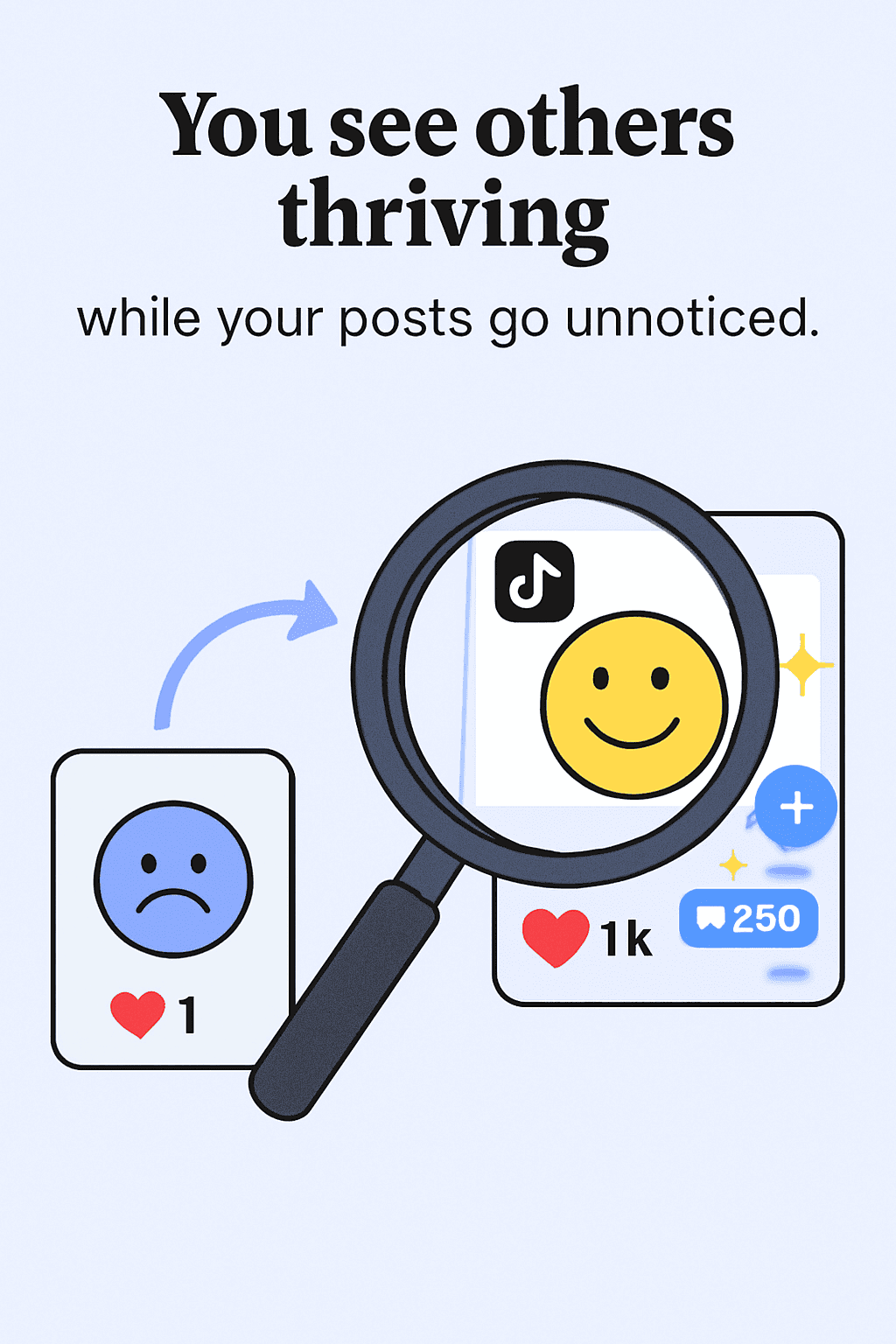
Use slideshows, not talking-head video
When a B2B founder hears “TikTok”, they picture filming themselves. Then they freeze for six months because they do not want to be on camera, and the channel never happens. The fix is to skip video entirely.
The slideshow — also called the photo carousel — is 9 static images TikTok auto-advances with a track behind them. No camera. No face. No editing software. The algorithm is currently boosting this format for product-led content because completion rate is naturally higher: the viewer is not deciding to keep watching, the timer is moving for them.
For B2B specifically this is the unlock. It removes the single biggest reason founders avoid TikTok, and it suits the content anyway — a workflow, a comparison, a list of mistakes all live better as nine readable slides than as a 40-second monologue. For a dedicated faceless playbook, read how to promote your SaaS on TikTok without showing your face. If you are still defaulting to talking-head video, see our breakdown of the three TikTok mistakes that kill most SaaS launches.
A good B2B deck has a predictable shape: slide 1 is a pure hook, slides 2-7 each carry one idea with a supporting visual, slide 8 is proof (a screenshot, a metric, a quote), and slide 9 is one specific call to action. For seven hook templates that consistently book demos, see our guide to TikTok slideshow hooks for B2B SaaS.
5 B2B SaaS slideshow angles that work
You do not need to be clever — you need a reliable angle. These five consistently earn reach for B2B SaaS without tipping into ad territory:
- The expensive mistake. “We lost $11k testing the wrong pricing model.” Specific cost, specific lesson. Your buyer fears the same mistake.
- The workflow teardown. Break down how a task is done badly today, step by step, then show the version your tool enables. Pure education.
- The before-after. The manual process — spreadsheets, copy-paste, four tools — versus the same outcome with your product. Contrast does the selling.
- The contrarian take. Name a belief your category holds and argue against it with evidence. Disagreement is the most reliable hook there is.
- The build-in-public number. A real metric — MRR, churn, a support volume, a conversion rate — and the story behind it. Numbers earn trust instantly.
Rotate these. One angle per week gives you a quarter of content before you ever repeat yourself.
A cadence a B2B founder can sustain
Daily posting is a vanity metric and a fast route to quitting. One deck per week is the right cadence for a B2B founder. The algorithm needs roughly 3-5 posts to understand what your account is about before it starts boosting you, so weekly gets you meaningful signal in about five weeks — and it survives a busy launch month.
Make every deck do more than one job. The same 9 slides post natively to TikTok, then to Instagram Reels and YouTube Shorts, and the copy can be cut down into a LinkedIn carousel. One angle, four channels. Batch a month of decks in one sitting and the channel stops competing with your real work.
The shortcut: stop designing decks by hand
Here is where the cadence usually dies. Building one 9-slide deck by hand in Figma or Canva takes 3-5 hours — writing the hook, sourcing visuals, laying out 9 frames, exporting 9:16. Four decks a month is most of a working week. No B2B founder sustains that past week two. We compared the main options in our Canva alternatives for TikTok slideshows roundup — the speed gap between manual design and AI generation is the real bottleneck.
Slidetik is built for this exact loop. Paste your B2B SaaS URL, pick one of the story angles above, and the AI returns a 9-slide TikTok deck with copy and on-brand visuals in 60 seconds. Regenerate any single slide for 1 credit until the hook lands, then post the same day. See pricing from €5/month.
TikTok for B2B SaaS is not a personality contest and it is not a video project. It is a weekly habit of explaining one real problem clearly. Pick an angle, ship a deck this week, and let the channel compound while your competitors are still deciding it is beneath them.
Ship the slideshow this week.
Paste your URL. Slidetik generates a 9-slide TikTok deck with copy, AI visuals and your brand colors in 60 seconds. From €5/month.
Try Slidetik — 60sFrequently asked questions
Does TikTok actually work for B2B SaaS?
Yes. B2B buyers are people, and people research on TikTok — it is the second-largest search engine for under-35s in 2026. The decision-maker for your tool scrolls TikTok after work the same way they scroll LinkedIn during it. Because under 1% of B2B SaaS companies post there, organic reach is still cheap, and slideshow-format content is being boosted harder than short video for product-led topics.
What should a B2B SaaS post on TikTok?
Useful, specific content tied to the problem your product solves: expensive mistakes you made, workflow teardowns, before-and-after comparisons, contrarian takes on your category, and real build-in-public numbers. Avoid trend-chasing, lip-syncs and anything that reads like an ad — that is what makes B2B content cringe.
Do I need to show my face to market a B2B SaaS on TikTok?
No. The slideshow (photo carousel) format is 9 static slides TikTok auto-advances with music — no camera, no face, no editing. It is the reason camera-shy B2B founders can sustain TikTok at all. You can add talking-head video later once an audience exists, but you do not need it to start.
How long until a B2B SaaS sees results from TikTok?
Plan for 4-8 weeks. The algorithm needs roughly 3-5 posts to learn what your account is about before it boosts you, so a weekly cadence means meaningful signal around week 5. Treat the first month as calibration, not failure — most founders quit one or two posts before it would have worked.
Keep reading
Faceless TikTok playbook
How to Promote Your SaaS on TikTok Without Showing Your Face (2026 Guide)
Promote your SaaS on TikTok without going on camera — the slideshow format, 5 faceless content angles, and a weekly cadence camera-shy founders actually sustain in 2026.
Read postLead generation
TikTok for B2B SaaS: 7 Slideshow Hooks That Actually Book Demos
Seven tested TikTok slideshow hooks for B2B SaaS lead generation — the exact slide-1 templates that stop the scroll, hold attention, and bridge into a booked demo.
Read postTool comparison
Canva Alternatives for TikTok Slideshows in 2026 (For Founders Who Hate Designing)
Canva is great for posters. For TikTok slideshows at weekly cadence it is the wrong tool. We compare 6 Canva alternatives — from AI slideshow makers to Figma plugins — and rank them by speed-to-post.
Read post